
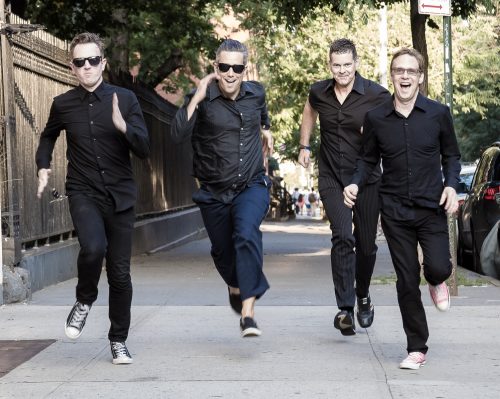
When Jon Ginoli and Chris Freeman started Pansy Division in 1991, the “queercore” band hoped that society would progress to the point where they would be obsolete.
“I remember early, like maybe in our third or fourth year, we were like, wouldn’t it be great if there was no need for a band like ours anymore? Wouldn’t it be great to write ourselves out of it, like there’s no need for a Pansy Division,” says Freeman, the band’s bassist. “But there still is.”
The San Francisco punk group’s unabashed embrace of gay themes, including explicit and sometimes humorous descriptions of sex, made them trailblazers and earned them fans in everyone from Willie Nelson to Rob Halford, the Judas Priest frontman who said he himself was inspired by Pansy Division to come out.
The band is celebrating its 35th anniversary with US dates, including stops at PhilaMOCA in Philadelphia on Sept. 18 (all ages) and TV Eye in Ridgewood, Queens on Sept. 19 (21-plus).
Ginoli, the band’s singer, guitarist and songwriter, and Freeman chatted with us about Pansy Division’s early days, how Green Day put its own reputation on the line to stand up for them and the challenges of making a new album – and why they think some bands should’ve stopped decades ago.
Has Pansy Division’s role changed as society has changed? Where do you fit in the music landscape?
Jon: It’s not like there aren’t gay bands or gay performers. There’s way more. There was hardly anyone we could point to who was out when we began, which is really the impetus to start the band. But now there are so many people out, so I don’t think you need to know about Pansy Division for there to be a Troye Sivan or a Conan Gray. On the other hand, they’re not rock musicians. I think we wanted to be gay and be a rock band, and these other people are out and gay and singing about relationships in same-sex terms in a more mainstream pop way. I think that’s great too, even if it’s not really to my taste.
How do you feel about the current state of the fight for equality and how does it impact your role as a band?
Jon: I have a happy life, but I’m angry about all these things that are going on in the world, and I know everybody else in our band agrees with that. There’s a backlash and America has a history of backlashes. What was so hard for me was the last time we did an album was 10 years ago, and after we did that album, I had intended to do a solo album, which I still haven’t done. At the time, I was ready to do it. Trump got elected the first time and it was like such a slap. It’s like, oh, you can’t just assume that things are moving forward. Also, how do you write music that isn’t just a topical song that is going to age poorly because it’s about what’s going on in that moment that you’re attacking? And I have not really found an answer for that. And I have so many songs piled up, but it’s like, what do you do? Like what is the right move to make? It’s hard to know what to do except to fight back in a certain way, right? I don’t want to fight back in a violent way. I like to fight back with our music.
We have a few songs that are directly political, but really not many. For us, the political statement is being and doing, rather than having to address this specific issue or that specific theme. So I think when people listen to our band, they get a certain feeling from it, a certain vibe from it, without us having to spell everything out. We spell everything out in other ways.
When you started playing shows as Pansy Division, did you deal with any pushback from clubs or promoters?
Jon: No, it was an easy rise, because of where we came from in San Francisco, the reaction to us was like, oh, I can’t believe it took this long for a band like you to come around. And it wasn’t until we started encountering the big time and a more mainstream audience with Green Day that we had any problems, but we didn’t have many. And I think that’s been true throughout our career. I think by being at a cult level of popularity, we’ve flown below the radar enough so we don’t attract the attention of people who would make life difficult for a band like us.
Green Day invited you to tour with them, then they were pressured to drop you from shows but didn’t. What was it like going through that tour?
Chris: Well, adding a little context to this, our first tour was the year before we went out with Green Day. So we did a little over a month the year before, and I will say that leaving our little region, we were really afraid, or I was anyway, because we didn’t know what to expect. So we were going through the South a little bit and places where we just had no idea what was in store for us. It was quite a growing experience.
Green Day’s got a huge amount of integrity that most people don’t give them because they jumped to a major [label], they were good enough to do that. They had a lot of integrity because, as you pointed out, there were places where promoters would call ahead and go, “Do I need to get extra security” or “What’s going on with this band?” And they would say, “Look out for that opening act.” So there was one place they tried to push us off the bill and Green Day said, well, then we’re not playing. And we were like, oh my God, you know, the fact that they had that kind of ability to say no. That was incredible. And the fact that they used that and said, no, we’re standing up here, we’re taking a stand on this.
Do you remember what town that was in?
Chris: Fairfax, Virginia.
Jon: And I remember the promoter, having a conversation with him saying, “The phone calls I’m going to get tomorrow morning from parents.” This is in the ‘90s. Virginia’s state motto is Virginia is for Lovers. Virginia had a sodomy law which criminalized same-sex behavior. It wasn’t really enforced, but it was there so that they could selectively enforce it. So I said to him, “You know, your state sponsors homophobia. We are giving an opposite message. That’s an important message, especially for teenagers to hear. So don’t give me this crap.”
Chris: Yeah, because he cornered me, because I had to go get paid. And he cornered me in his office and he said, “You know, there are eight-year-olds out there.” And I said, “Well, look, there’s no rating system for bands, but my parents didn’t let me go to any concerts until I was 16. So that’s on the parents.” And take a look out there right now: Green Day, Mike and and Billy Joe, were swapping spit, like hocking loogies in the into the air and catching it and then talking about smoking pot from a bong, I’m like, is that any more appropriate for an eight-year-old? So don’t give me that shit. Your headline act is doing some things too.
As far as new material, you mentioned it has been 10 years since the last Pansy Division record. Are you guys planning to put out more music?
Jon: It’s hard to have a band who live all in different places. I moved to Palm Springs and that at least puts me within an hour and a half of Chris again. But I really didn’t want to make an album by mail. And we haven’t had the time to do an album. I would be open to doing it. I just think it’s going to be really hard to do because we made our best albums when we were out on the road playing the songs live before we recorded them. That’s almost impossible to do anymore. So I, I don’t know. Chris, what do you think?
Chris: Well, I remain hopeful. I mean, in the past Pansy Division albums began with a clutch of songs that Jon would have. He’d go, OK, I’m now at a point where I feel like we could make an album, here are some songs that go together. And then I would kind of write to fit in things that would fit. And Joel the same way. So if we’re going to do something like that, we’ve got to have the other two out and work on a batch of songs in California, and then we would have to make a tour and then play like three songs a night that are new or something, just to sort of air them out. It’s not impossible.
I never want to stop making records. I love making records, but I also am very clear that some bands should stop making records. Like I think Rolling Stones should have stopped at “Tattoo You.” I mean, there’s not been a really good album since “Tattoo You.” So we’re very cognizant of like, OK, well, let’s not put out inferior stuff. And even now I look back at some of the songs that I’ve submitted and I’m like, yeah, that wasn’t the best that we could have done at the time. So I think it’s really important that if we’re going to keep putting out material that it matches and comes up to the level of our past.
Jon: Weput on an album 10 years ago, and I don’t think that many people listened to it, and I think if we put out another album now, that would probably be the case. So that’s inhibiting too. It’s like you do a lot of work and you want to have your, I don’t want to say product, but have your creation, have some attention because you’ve got all these other records already. This is the problem with being a band that would be making their 10th album, which is, what do you do that you haven’t done? Plus, how do you vary it enough to make it so you’re not doing a retread? That is hard, and I think that’s where bands trip up. This is us being rock fans, right, and trying to think about our own band and the way we think about other bands. It’s like, is most band’s 10th album the one that people are going to remember and love? Probably not.



Leave a Reply