
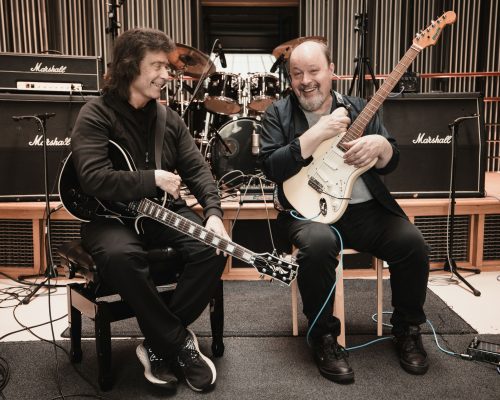
Steve Rothery, one of progressive rock’s most revered guitarists, recalls preforming with his hero turned friend and collaborator Steve Hackett during one of the latter’s Genesis Revisited concerts at the Royal Albert Hall. The song was “Fly On The Windshield” from the Hackett-era Genesis album “The Lamb Lies Down on Broadway.”
“The challenge in that situation, because we hadn’t set a length, is like pulling rabbits out of the hat. Every time you get to your turn, you try and do something different. He does a bit. You go back to your turn, OK, what can I do this time? And it went on a lot longer than I anticipated. I thought we’d do it for like a couple of minutes that’d be it, but no, we explored all the possibilities, you could say.”
This type of playing, the Marillion guitarist says, “demands complete focus and concentration and ‘what the hell do I do next time?’”
The musical exchange is illustrative of Hackett and Rothery’s new instrumental album, “The Roaring Waves,” long awaited by progressive rock fans. Despite the two guitarists’ pedigree and skill set, there is next to no shredding: the music comes in cascades rather than jagged bursts.
Six-string nerds hoping to clock which Steve is playing can pick up on some signifiers, but it’s not as simple as Hackett being placed in your left headphone and Rothery playing in the right.
Hackett says, “We mixed it and we thought, OK, people won’t know who’s necessarily playing, but they’ll probably pick up on the character of each of us. And there are moments when we’re playing together. For instance, on the title track, ‘The Roaring Waves,’ it becomes a slow wall where we are playing complementary parts to each other, but we’re not playing harmony, but we’re playing simultaneously, it seems as if we’re playing around each other, and it’s one of the best moments on the album.
“You’ve got two melodies that are not fighting for supremacy, but you’ve got two that are complementary to each other, but two melodies at the same time. That doesn’t often happen, not within rock.
“It’s one of the natural moments that that occurred spontaneously as we were both being ourselves.”
Four of the seven songs have their roots in a 2017 session at The Racket Club, Marillion’s studio in Buckinghamshire.
“It was just Steve and I at the Racket Club,” Rothery says. “I had my backline and a little setup for Steve there with his small pedal board, and I had my laptop, and I recorded everything in Logic and I was using EZdrummer for some drum rhythms for us to play along with. The first idea we worked on is probably pretty close to what it finished up as, which was the ‘Sandsend’ idea. I had an idea of the feeling that I was after, and I had some chords I thought could work really well, and Steve picked out a melody based on the changes, and I added another two or three different musical sections to it and it just kind of evolved. It was probably the easiest track to come about in that respect. It needed the least work.
“Then something like ‘Pacific Coast Highway,’ again, I’d get a drum rhythm going and I come up with lots of different sort of like jangly kind of riffs. And then, you know, you go away.
“Some of this stuff was on the shelf for a long time, but the good thing about that is you can bring it down off the shelf, and you can play around with it and chop it together in different ways and hopefully finish it with an arrangement that you’re happy with.”
“Pacific Coast Highway,” the bluesy closing track on the record, also features Hackett’s harmonica playing. For context, Hackett mentions his previous harmonica work on his 1994 album “Blues With a Feeling,” which he says was a “kind of silent tribute to Paul Butterfield amongst others, because he was himself paying tribute to other great bluesman. Little Walter, for instance, Howlin’ Wolf, Sonny Boy Williamson.”
He continues: “I spent time with one chromatic genius, Larry Adler, and asked him about one or two techniques because I used to play harmonica 10 years before I played guitar, 10 years before I touched the guitar. When I was 12, I’d been playing or attempting to play harmonica as a tiny tot, doing exactly what my father did, and then for my fifth or sixth birthday, he bought me a chromatic because he knew that I was dead serious about it.”
“It’s a very expressive instrument,” Hackett adds. “The harmonica at times, if you’re not really keyed into what it is, you might assume that it’s electric guitar, but it’s slightly more trumpet-y when mic’d up and put through an amp. If it’s got an edge on it, it can sound a little bit like a trumpet, a little bit like a brass instrument. Of course, as soon as you overdrive a guitar, you’re sounding a little bit brassy. But Butterfield was the guy who I saw live in 1966 when I was 16, and I saw him with this incredible sound with incredible vibrato. And again, by consulting various people, I learned how to emulate that.”
Nautical themes permeate the record, a notion connected to Rothery’s upbringing on the English seaside. He had brought Hackett on a visit to Whitby, the small Yorkshire village where he spent most of his youth.
“We moved from South Yorkshire, which was like a mining community where I was born, and my grandfather was a miner who also played the banjo and was a keen photographer, which was my other obvious passion,” Rothey says. “But we moved there when I was six to a little village just outside of Whitby called Newholm, which is like a mile and a half from the sea, and then into Whitby itself from 11 till 19 when I moved down to join Marillion. So the sea was always a very important part of my youth.”
One of the oceanic songs, “K-129,” was informed by the story of the Soviet submarine of the same name that sunk. The song is haunted by a pinging akin to a sonar pulse.
“It actually grew from the sequence which is a preset in the Diva software synth and I just sort of set it going,” Rothery explains. “I’d been working with Thorsten [Quaeschning] from Tangerine Dream as well, which probably bleeds through a little bit in that kind of influence really, as well as the music, which again is inspired by Tangerine Dream in ‘Stranger Things,’ that kind of very hypnotic, pulsing, repetitive thing, and then me trying to not do the obvious thing on top of it, and Steve doing a similar kind of approach until we could build up little melodies and moods and flavors that would sort of give it somewhere to go.”
Now that “The Roaring Waves” has washed ashore, an obvious question is will the Steves tour together?
“I think there’s every chance that that will happen,” Hackett says. “At the moment we’ve got wall-to-wall schedules with our own commitments. We’ve talked about the idea of doing perhaps another album, which might be slightly heavier in spirit, and then to have two albums to choose from to craft a stage show from. So I hope that happens at some point. But you know, it did take eight years with this, and that’s not because we weren’t keen on finishing it. It was just that our mutual schedules were so jam packed with live shows, recording schedules, blah, blah, blah, blah. Everything, everything, everything. So some years we were barely able to do more than just say hi on the phone.”
The album, out on the progressive label Inside Out, has found an audience primed for it, debuting at No. 24 on the Official UK Albums Chart. Germans took to the album as well, putting it in the top five of the country’s midweek album charts upon its release, and in the US, it landed on Billboard’s Hard Rock and Independent Albums tallies.
“On YouTube, between Steve’s channel and the record company’s, the comments are just really lovely from people who’ve been waiting for this for a long time,” Rothery says. “Maybe for the real die-hard prog fans, there’s been nothing that they could really embrace for the longest of times, with maybe the exception of Steven Wilson, and that’s not to everyone’s taste. But I think there is that sense of, well, yeah, this is what we’ve been waiting for, two prog rock guitarists doing what they do.”

Leave a Reply