
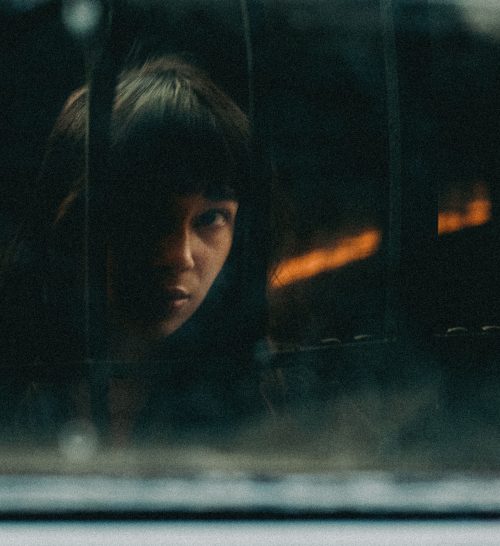
Ruby Alexander’s two new songs, “Undertow,” released today, and “All This Time Together,” which she shared in July, come just two years after her debut recordings, but they might as well be landing from a different universe. While the 2024 material shows a talented young artist finding herself, the new music sounds like an arrival.
When I remark to the Australian singer-songwriter that I had perceived a shift between the two sets of songs, she says I’m not the first one to tell her this.
“It really reflects a natural evolution that has arisen from playing live,” says Alexander. “It’s been the biggest needle that’s shifted. After I put out my first EP, which was a lot about exploration and just trying things in terms of engineering, getting comfortable in the studio, working with other musicians, I realized that I needed to take a step back before recording anything and figure out what my sound is in a living, breathing space, not just in a bedroom, you know? So, I made it my goal to play as many shows as possible.
“I found an amazing band. It was a three-piece setup of a sax, keys and me on guitar. It pushed me to get a bit further into jazz and soul, and I liked that it felt right.”
Her approach to writing lyrics has evolved as well.
“I think in the beginning I was writing from a lot of inspiration from books, films, kind of living outside myself and delving into imaginary worlds,” Alexander says. “I still have one foot in that, like an imaginary, otherworld realm. But I needed to slap myself in the face and just be brave and take things from my own life. I think it pays off because that’s just real. And when you sing what’s going on in your life, it’s inevitably more resonant.”
Which brings us to “Undertow,” her haunting new ballad, which will be featured on a her new EP in November.
“’Undertow’ isn’t inspired by one person or one particular event. It’s more a mix of experiences over a few years. But predominantly, I was in a place where I felt I could step out of my recent past and look back without holding on to bitterness and being able to see things with hindsight. ‘Undertow’ actually came from just a lot of questioning, and I think that instead of filtering that into finding answers, filtering that into making decisions about, ‘oh, it happened this way, it happened that way,’ I just kept the questions in and I thought maybe the questions are more interesting than the answers. Questioning yourself most of all, even reality. It’s so human and it’s just interesting, I think.”
Two artists Alexander was listening to when making the song were the Irish singers Damien Rice and Lisa Hannigan, calling the latter “the main player in that,” noting that “her backing vocals were a common thread throughout my childhood.” In the context of making “Undertow,” she says, “that was a north star for me, that haunting, very intimate quality that doesn’t need you to belt for people to hear you.”
Growing up, she loved Joni Mitchell, Cat Stevens, Roberta Flack and Richie Havens and “of course The Beatles,” then got into Massive Attack. “But I can always distill it down to folk,” she says.
Alexander’s musical palette is pan-genre and pan-national, which is mirrored in her pancultural makeup: she was born to Chinese and Greek parents in Australia, studied at NYU’s Clive Davis Institute and conducted our interview from London. She also worked in musical theater as a child, including playing the role of young Nala in the Sydney run of “The Lion King.”
Her travels, she says, have inspired her as both a lyricist and composer.
“One side is storytelling,” she says. “I think it just makes you more receptive to the fact that the most absurd stories are true, like people’s realities are so diverse, so I think you can stretch your imagination and push yourself to the edge. And then on the other side, sonically. When I was in Morocco, I listened to a circle of drummers, and they weren’t professional drummers, it was just a bunch of guys hanging out drumming, and they were playing these polyrhythms that I could not wrap my head around, it’s not in standard time at all, and they were improvising and it was just a completely different pocket rhythmically that’s ingrained in them. And I just thought, ‘Oh my God, it’s like something I haven’t even delved into.’
“Even off the top of my head, I was in Chicago a few months ago and we’re in a taxi and the driver is like, ‘Do you mind if I play some music?’ And he put a CD and it was like East African and I’d never heard anything like it before. The recording was so shoddy, it’s just a singer and a guitar, but those kinds of Arabic scales that I didn’t grow up on and just the quality and tone of the voice is so different.
“You’re picking up things all the time and it just makes you really excited. At some point, I’d love to delve into all of that if I have the time.”
This interview was edited for length and clarity.

Leave a Reply