
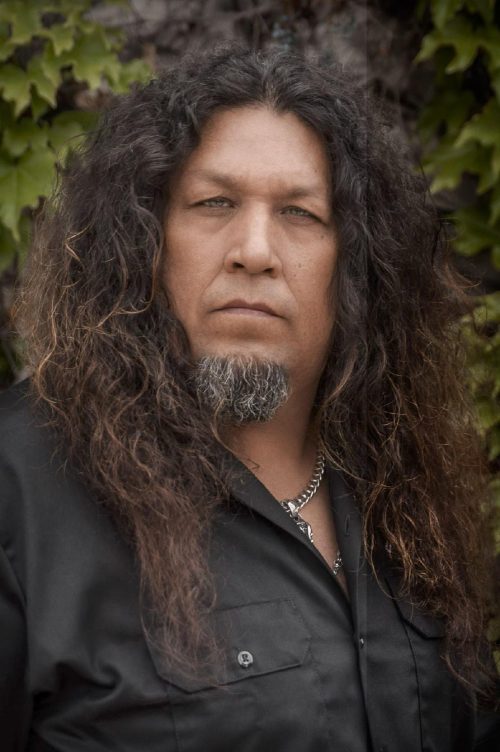
Even if Chuck Billy wasn’t the frontman of Testament, one of the most successful and influential bands in thrash metal, his life story would be worth telling in a book. His father was a full-blooded Pomo Indian who grew up on a reservation. His parents met in a tuberculosis sanitorium in the 1940s. Growing up in the San Francisco Bay area, he got into drugs and stealing. When he was afflicted with a cancerous tumor near his heart, he worked with a medicine man – their meeting was foretold in a dream by a mutual friend — frequented sweat lodges and participated in native ceremonies in addition to traditional healthcare to battle the disease.
“Holding My Breath: The Two Testaments of Chuck Billy,” out this week, is an autobiography about a man, not a musician’s memoir, although stories about how he came to join Testament and the ups and downs of the group are a backdrop of the narrative. Readers will learn about his upbringing, his athletic prowess and how he worked a day job at a trucking company to make ends meet even after he became famous
Billy recently chatted with Highway 81 Revisited about the book and offered an update on new music from Testament, who will perform at Brooklyn Paramount on March 3 with headliner Meshuggah and fellow support act Blood Incantation.
There’s a lot in this book that I think even diehard fans of Testament didn’t know about.
That’s what it’s about. I didn’t tell those stories during my interviews for the band, which was all about the band, not about me, you know? So, I think that’s what I wanted to accomplish in the book, was to introduce the person that they don’t know that found his way to be the lead singer for Testament.
What made you want to share these stories?
When I first was approached about doing this, it wasn’t on my bucket list. I was, like I said, private. But for me, doing this book is very cathartic. After you talk through it, and I really saw how some things in my life have met at different intersections when they needed to meet and made their connection to get me through to where I am today. Especially looking at it from when I was supposed to be maybe gone at age 38 and finding my way to beat it, beat my way through that, and especially telling my story, going back to holding my breath and analyzing and talking about it. I was that stubborn kid holding his breath, getting his way, and his father raised him to be tough, fight and stand up for yourself and all that, and maybe all that was preparing for that battle with cancer.
How did it feel to revisit your youth, when you were involved in some unsavory and sometimes illegal activities? Did it bring up any feelings of regret?
Well, it’s who I was because I was always the jock, but I was always hanging out with the guys that like to steal and smoke cigarettes and get in trouble. Those were the fun guys to hang out with. I was on the wrong side of the fence growing up but had the jock mentality and wanted to have a future in sports possibly or at least maybe get an education through sports somehow, because my parents couldn’t pay for it. When all that kind of went to shit my senior year, music was plan B and I was very fortunate the way all that played into place, not being a singer, trying to learn how to be a singer, auditioning and landing my first gig, and still here 40 years later.
Do you feel a responsibility to represent your culture as an American Indian and a Mexican American?
I don’t know if it’s a responsibility, but I guess if I can still be able to go perform places and I guess be maybe a symbol of hope for some people that may be ill or going through cancer and they want to chat about something because of what I went through. I always say I don’t have the answer. I only know what I did and what I needed to do to get through this. And all I could say is your mental power is very powerful. You use that. That’s what got me through it, and that’s the only advice I’d ever have to give really.
When you visit Native American communities, are they aware of your music career?
They’re all aware. They’re all proud that a Pomo tribe member is a big rock star or whatever. So, like when we have an annual fry bread competition up there in Ukiah, that’s where all the local dancers from all the tribes come down and they dance, and we have a jazz band playing, and I’m the emcee, and we give out prizes and we do all kinds of fun things. We judge the frybread and the dessert contests. And they have all kinds of cool historical photo books of archives of old families. I go back there and see my parents and father when he’s young and these old photos. I’m the emcee, so I’m the representative of our tribe as a celebrity, I guess.
You talk about your sports background and love of golf in the book. What sports and teams do you follow?
A huge Raider fan. But now I’m just. God, I’m so torn with team moving from Oakland to LA to Oakland to Vegas. But I’m still a Raider fan at heart. World Cup, I love that, that’s a big, big event. I love golfing and watching golf. My wife hates it, but I love it, you know?
What’s next for Testament?
A lot. We’re getting ready to go to South America this month. We have a very busy first quarter next year. And Eric [Peterson, guitar] and Chris [Dovas, drums] already have enough music for the next record, and I think we’re already shooting to get in the studio hopefully by next summer. I mean, that’s our goal. So, we’ll see. We’re setting a goal for that.
This interview has been edited for length and clarity.


Leave a Reply