
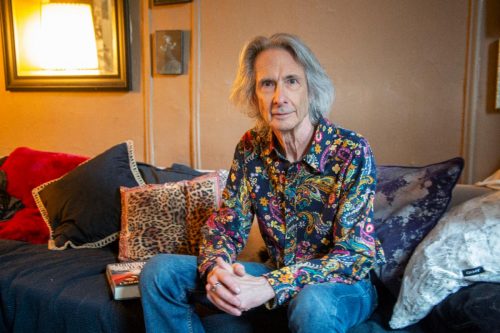
Lenny Kaye is grateful for a career that started in the 1960s and has brought him critical acclaim, praise from his peers and a musical partnership with Patti Smith that has provided an opportunity to perform on grand stages at Glastonbury and the Rock and Roll Hall of Fame.
He is happy to talk about producing an EP for Allen Ginsberg on which Paul McCartney and Philip Glass recorded, or “Nuggets,” the 1972 garage rock compilation he curated for Elektra. He has written three of his own books and co-wrote Waylon Jennings’ autobiography.
But when it comes down to it, what really satisfies Kaye, 79, is going local: seeing one of his buddies playing at a bar near his home in Stroudsburg, Pa, or playing his own music in a similar spot.
It’s a spirit that flows through his first solo album — titled “Goin’ Local” — released in July. His promotional appearances for the album included an interview on NPR’s “Fresh Air with Terry Gross” and a Grammy Museum-curated conversation with “The Sopranos” star Michael Imperioli.
With the press blitz over for the album, which includes a guest slot by Smith, he’s going local again, DJ’ing at NYC haunts, bumping into compadres like Elvis Costello at The Bitter End and playing intimate gigs, including Saturday, Oct. 17 at Sleepwalk in East Williamsburg, Brooklyn, for Highway 81 Revisited’s 15th anniversary bash.
Kaye chatted with me about how smaller-scale shows fulfill him, why he gave Pennsylvania girls some love on the new album and why feeling inspired doesn’t mean he feels the need to put out a slew of new work.
Tell me about the album cover, a nostalgic image of you standing on a block on the Lower East Side?
I lived in the building next door to that theater all in the ’80s and ’90s. It’s 3 or 4 Bowery. The theater is located at 302 Bowery. And I’m all about the local. I love to see my friends play at their hot spots. I hardly ever, when I’m in New York City, go up to the “normal drome” and see the big stage spectaculars, even though I like them. My favorite thing is to go to my local and see my friends show out. It’s intimate, it’s real, and it’s kind of the basic building blocks of music.
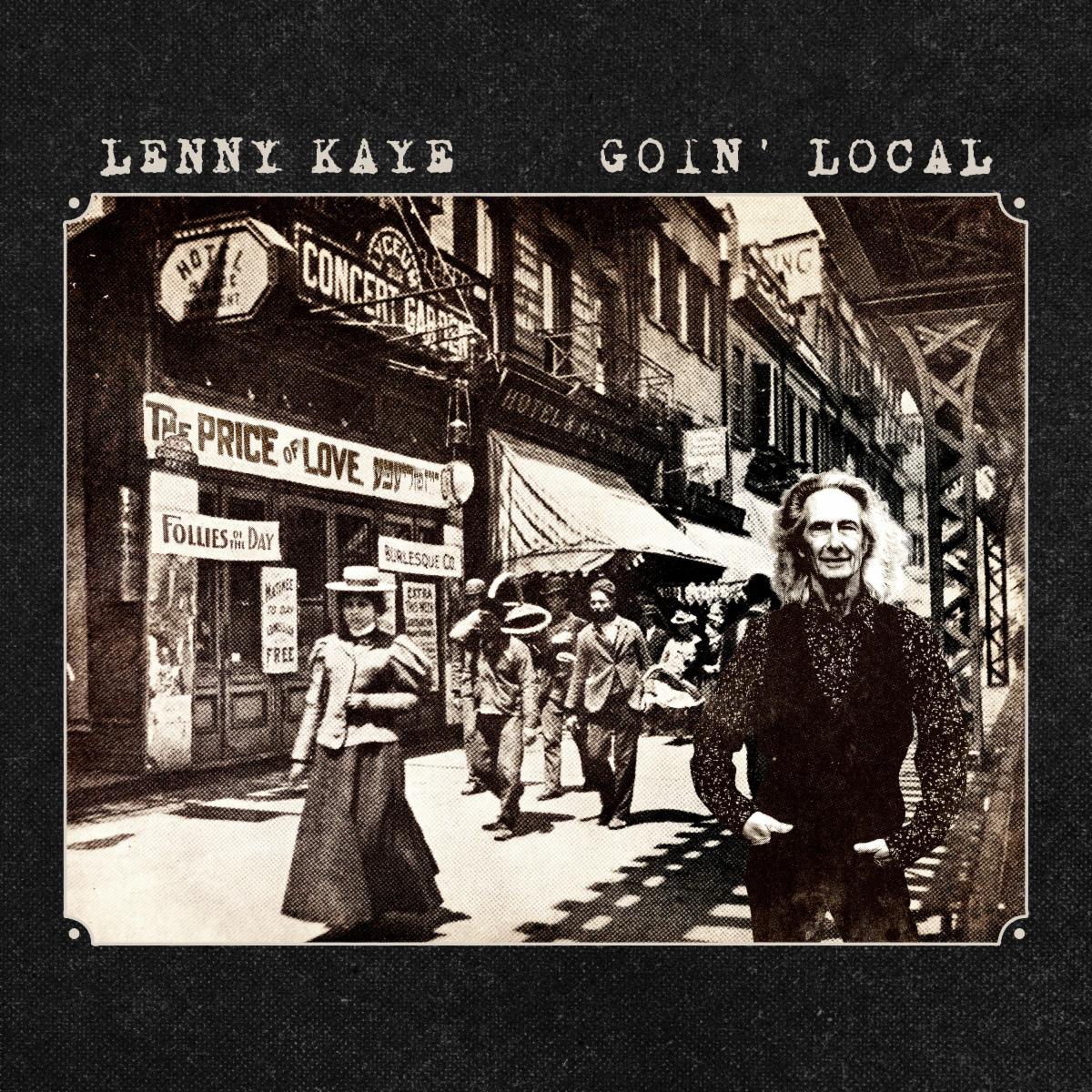
I love that cover picture. I discovered it, I don’t know, 20, 25 years ago, because I lived in that building. In that time, if you stand in front of CBGB and you look in the 10 o’clock position, that’s my building where I lived all through the ‘80s and ‘90s and I always loved that. And it was great to insert myself into it and to see the Yiddish theater that was next door to me, because that to me is the beating heart of music when it’s at its most local. And we have a very sweet little music scene [in the Stroudsburg area]. I’ve played stages all over the world, big ones, you know, Fuji Rock and Glastonbury and theaters and all of that, but my greatest satisfaction is when I’m playing to those four or six or 20 people at my local dive and communicating with them one on one.
Is it harder to “go local” in New York City now than it was then?
The East Village is not what it used to be. That’s kind of a cliche. I’m sure there’s a lot of local out in the boroughs. The local kind of moves around in my book. “Lightning Striking” [his 2022 book] is all about how the local becomes global, that all of a sudden a spark happens, a kind of creative cauldron erupts, and suddenly it spreads all over the world, and I really like that. To me, that’s a beautiful thing. I was most influenced when I was a kid by the San Francisco scene, and I always remember that moment standing outside CBGB thinking, this has a lot of comparison with that scene. You have six or seven or eight bands, all somewhat different from each other, and they’re starting to get noticed and they’re starting to change the face of rock and roll. That to me is a beautiful moment in time, and I’m so grateful I got a chance to experience that in the mid-70s.
Tell me about the song “Pennsylvania Girls” on “Goin’ Local.”
Well, I have a Pennsylvania girl now, and she actually is a co-writer on that song. She gave me a lot of the lines, you know, “Pennsylvania girls can drink you under the table.” “Pennsylvania girls, they fly under the radar.” I wound up here 39 years ago, amazingly enough, and I had no idea where the hell I was. I thought Pennsylvania was somewhere out in the boondocks, even though it’s only an hour and a half from New York City, if the traffic’s right. But I’ve grown to love it here. It’s kind of the gateway to America, and it’s a great place to have a perspective on the cauldron of New York City, which has such manic energy. And I think that Pennsylvania girls kind of need a good nod. And I love that song. It just grew organically, as most of the songs on my record, because they needed to be written. I didn’t set out to write an album of hits. In fact, if I would have, it would sound a lot different. I wrote songs that had meaning to me that needed to be expressed for me to understand a relationship, a situation, a time and place.
Another song I really like is “World Book Night.” Is it about reading the World Book Encyclopedia?
No, no, no, I mean, the World Book Encyclopedia was a touchstone of my childhood. We all had them and we all looked at them. But World Book Night was a holiday or a day that seemed to be around for a couple years anyway, where publishers would donate books to people who would take them out to subway stations or beaches and just hand them out randomly, and I thought that was a beautiful thing. But of course, I am a writer. I love books. I have far too many of them, if you can have too many books, which is, of course, a great luxury problem. And I just love reading. In third grade, my friend Richard Rudin and I would meet up during lunch and say, “Let’s talk about books.” I wanted to be a writer, probably more than a musician. Thankfully, both of them seem to encourage each other.
It’s my little tribute to what I do when I’m on the road and I go with Patti and we find a local bookstore and she shows me a book I’ve never heard of, which is brilliant. And it’s a great literary tribute to the pleasures of reading and writing.
Why did you make “Goin’ Local?”
I needed artistic closure on these songs because I felt like I’d like to see them revealed to me. … I have at least one more solo record with me, and then I have my goth psych jam band Adrift, which has eight songs and which is a darker persona than I am. If I get that record out and another solo record, I’ll feel creatively complete as I do with my three books. I don’t feel the need to write another book. Those books have a place in the world. I’m not anxious to just pile up a bunch of stuff, because there’s a lot of detritus out there, so many records, so many books. So, if you’re going to do something, make it meaningful.
I didn’t try to show off. I just made the record that’s inside me. That to me is a beautiful thing. I’m not going to run this pony into the ground. I don’t really care. I’m not going to suddenly be like, “Whoa, I’m a solo artist. I got to start churning it out.” I don’t want to churn it out. I’d rather sit on my porch, smoke some pot and gaze off into the sunset. But right now, I feel really energized by the response, by the open-heartedness of people like yourself talking to me, and the sense of accomplishment I feel about the record. I mean, David Lynch has the greatest phrase: The pleasure is in the doing. And when I leave the studio after six hours and I’ve put together a vocal and maybe a guitar solo and maybe even a keyboard pad, even though I only use my right hand, so I’m not really a keyboard player, I feel like I’ve lived up to who I’ve always hoped to be, and that’s that. That’s a great thing, especially so late in life.
What did you take away from the experience of working with Ginsberg?
The Beats changed my life. When I was a kid, maybe 14 years old, I was enamored with Beatnik culture. Reading “On The Road” at that moment in time just filled me with a sense of “rev up, get on the road, have a good time.” Allen Ginsberg, one of the great poets and political thinkers and spiritual thinkers of our time, Gregory Corso, William Barr. These were my heroes. When I got to meet Allen and we did what would become “Ballad of the Skeletons” at a benefit at Carnegie Hall for Tibet House, and I was a bass player, and he’s doing his thing and I’m playing the bass, and when it came time, he just came over to me and said, “Come on, let’s get it right. You know, go crazy.” And so I did. And then I was asked to produce this song. It was just a great honor. He would do his poetry thing and then, you know, I don’t know, “Allen, can we do that line a little better when we drop that line in?” Paul McCartney wasn’t in the studio at the time, but he was in England. We sent him the tape and I’m playing bass to Paul McCartney’s drums. I mean, that’s kind of mind-blowing. Philip Glass is on there, David Mansfield, who orchestrated the last track on the album, “Yes, I Will.” Marc Ribot. It was a great, a great moment in time.
I always remember Allen taught us the way to walk on the world as a Buddhist, because you have to be aware that the earth is an orb, so you place your feet as if you’re walking around the globe. It was a beautiful moment in time.
You mentioned that you have another solo album coming. Is it a sort of companion to “Goin’ Local” or something very different?
It’s kind of a companion piece, my next solo record, and I’ve gotten so much approval for this one that I will get the chance to do it. There are some songs I had left over, three, four songs that I didn’t think were right for this record. I’ve written three since then, including a very long narrative piece called “Buddy Holly’s Motorcycle.” I just like doing my work. To me, it’s one of the ways in which you keep alive. I think it’s a really good follow-up solo record. And I have the Adrift thing, where we have eight songs recorded and another two in the hopper, which is enough for a record. Again, I don’t have any sense of destination. I’m doing this for my own artistic pleasure. I don’t expect to make any money out of it. In fact, I’ll probably lose it since I’m paying for all the studio time myself. But really, I don’t care, you know? To me, the fact that I can go over to Delaware Water Gap, do six hours, go over to the Minisink Hotel right down the street from me in Shawnee and have a couple drinks and feel like I’ve done my work in this world.
Some of us never get to this point.
I’m just lucky, but also I got there because I believe in hard work. With Patti, I like to make money as much as the next guy, but we never got rich. I didn’t do this to become famous. I didn’t do it to become the cliche of a rock star. I don’t have five bangles on my arm and a bone in my nose or whatever. I did it because I love the music and I love doing the work. And that to me is why I can still do it with a sense of honor and respect and accomplishment.
Photo by Bob Gruen


Leave a Reply