
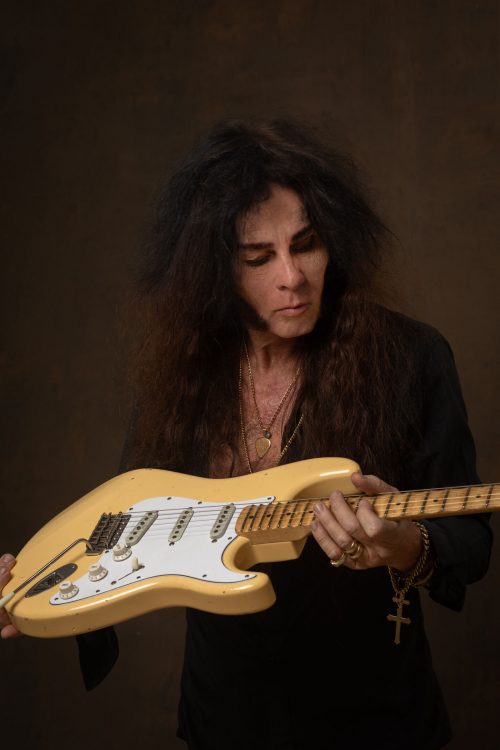
Yngwie Malmsteen’s new album “Hell or High Water” is another chapter in the larger-than-life Swedish guitarist’s story, complete with the dramatic melodic statements and classically inspired pyrotechnics on the fretboard that have won him countless fans — and critics — the world over.
Forty years into his solo career, the virtuoso is still finding inspiration in topics current and ancient, earthly and extraterrestrial. “Father,” the album’s final track, is a loving instrumental tribute to his dad, who died last year. Other instrumentals include “Antikythera,” inspired by a device from the second or first century BC that is widely regarded to the oldest known analog computer, and “Beyond Zeta Reticuli,” named for a distant star system and inspired by Malmsteen’s interest in alien life. And on the songs with vocals, he does the singing himself, like he did when he started out years ago.
Seated in the recording studio in his Miami home and holding one of his prized guitars, Malmsteen recently chatted with Highway 81 on a video call about his beloved departed dad, how his love of reading and film informs his songwriting and why he needs all of those Marshall stacks on stage.
I’m sorry to hear about the passing of your father. How old was he?
90
He had a long life.
Oh yeah. He was in actual battle. He was in war zones. He was a smoker and a drinker. He learned how to speak fluent Russian and became a spy on the Soviets in the ‘80s. Not like a James Bond. He was UN special forces. He was really something else, this guy. And a musician.
What did he play?
Guitar. But he was never a pro. His younger brother’s a professional opera tenor, and his older brother, who also passed, he was an illustrator, the most established illustrator in Sweden.
So there’s been a lot of art in your family.
Only all the time. Everywhere. I was very lucky that way because they would let me kind of run free, you know?
Do you like singing?
Yeah, sure. Yeah, yeah, yeah. I mean, having said that, I do believe that I’m improving on it for each album here. It’s all going in the right direction.
I had never heard about the device that was discovered on the Greek island of Antikythera that inspired your song of the same name. If you’re writing about stuff like that and outer space, I wonder if you’re a big reader.
I grew up in a country in an era where there was no TV, there was no radio. It was like a big black hole. It was like a void, basically. So I was very, very, very young when I became a reader, both in Swedish and English. I was just a little tyke. And I would read everything from history to science to Edgar Allan Poe, you know, whatever. So yes, movies and books was always my thing. I still love it. I still love movies and books. It’s just not that many good movies anymore. So that same thing with “Zeta Reticuli,” right? That’s also according to the gray alien himself. That’s where they’re from.
When you come across the story, how do you set it to music and how do you tell the story without lyrics?
It’s not a set way, really. For instance, “Black Star” was the name of the stone that I had in one of my rings when I was little kid. Or “Far Beyond the Sun,” for instance, we’re talking about old stuff now, so the little wordplay on that with “Beyond Zeta Reticuli.” It’s even more specific beyond that star system, not just the sun.
You’re known for a very specific aesthetic, visually as well as sonically. Why have you presented yourself the way you do? Why the rows of Marshall stacks?
I wanted people to see what I would have liked to see if I went to a show. I want to make music that I would like to hear if I went to a show. I don’t want to see some guy just standing there. It’s gotta be a show. And the Marshall stacks to me, it’s a feng shui, you know? I got them right here. I got 59 Marshall heads sitting against the wall, and the speakers are downstairs. They’re like in this old mansion. When it was built, they had servants in the house, like there’s little separate servants’ quarters. I call it a room of doom. That’s where the speakers are mic’d up and it comes up here in this control room here. And the guitar is now steady volume, but I’m here controlling it. It’s perfect. It’s a vibe, but it’s also the best sound.
I’m also extremely picky with the lighting and the smoke. I don’t like white lights.
How many of the Marshalls on stage are actually running at your shows?
It depends on the place. But for instance, I did a show in, I can’t remember where I was now, I was in Bulgaria or something. I blew up seven heads in one show, seven heads, and two of them went on soundcheck.
Oh my God.
Yeah, because they weren’t mine. But when I fly into like Japan or Australia, there’s a rider where they have to have X amount of Marshalls, X amount of double bass drums and all that stuff. And nobody does what I do. I play at 11 all the time. So those Marshalls, they’re not used to that. They’re used to having somebody at 2 or 3. And so I come in and I make sure that they do their part, and they don’t last all that time.


Leave a Reply