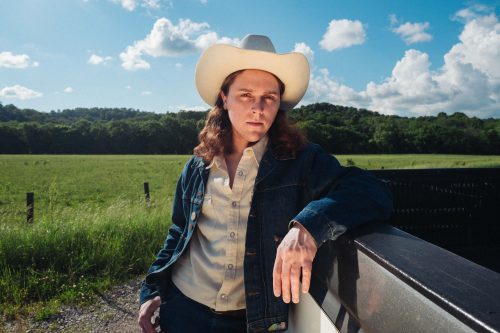
Daniel Donato is celebrating a full-circle journey every time he steps on stage. From his teenaged days as a busker in Nashville to playing at Red Rocks and everywhere in between, the New Jersey-born guitarist, singer and bandleader is on a “hero’s journey,” a term he uses to not to brag to explain his arc in a narrative and philosophical sense.
That heroic quest is memorialized on Daniel Donato and Cosmic Country’s new live album “Ryman to Robert’s,” on which Donato and crew perform at the storied Ryman Auditorium in Nashville before decamping down the block for a set at Robert’s Western World, the small venue where he got his big break.
In addition to leading his own group, the musician who blends Americana, psychedelic rock and jam band flavors has performed as a member of Billy and The Kids, the band led by Grateful Dead drummer Bill Kreutzmann, and has also played with Bob Weir and Phil Lesh, the Dead members who recently passed.
Ahead of his show with Cosmic Country at the Capitol Theatre in Port Chester on Saturday, Donato went deep with Highway 81 Revisited on the new live record, the advice his mom gave him before he played with Bob Weir and why Americans love their country even in the worst of times, even if they might not realize it.
Why did you decide to make “From Ryman To Robert’s?”
Nashville is full of so many fantastic, talented entertainers, but there’s never been an entertainer that started out on the street, grew to the honky-tonks, grew to the Ryman, and then on the first night of playing the Ryman went back to the stage where they cut their teeth and memorialized it, recorded it, captured it, framed it in a picture, so to speak, and to share it with the world. It’s never been done. When I played downtown, I remember playing down there and seeing Sierra Ferrell down there, Ashley McBryde down there, I remember seeing Sturgill Simpson play at Robert’s, and I saw a lot of fantastic artists cut their teeth down there, but they never put out a record that actually memorialized that story, that hero’s journey in that Joseph Campbell sense, so to speak. So it is full circle.
Do you have any special memories of playing at the Capitol?
Oh, tons. Playing with Phil Lesh for his 80th birthday or was that his 84th birthday? That was really special. Getting to share the stage with Grahame [Lesh] and Mike Gordon and John Molo and all those fantastic musicians and Cosmic Country. Our first time Cosmic Country played there, we opened up for Leftover Salmon. We did a co-headline show with them, so to speak, and that was brilliant. And there’s also some other fun memories of hanging out with Peter Shapiro there until three in the morning.
Your mom is a Deadhead, right?
Yeah. More or less, -ish, yeah. She was a fan of the Grateful Dead’s music, that’s for sure.
Did she get to see you play with Bobby, Phil or Billy?
She did, she did online.
What was that like for her?
You know, that’s the funny thing. I guess it’s funny, it’s also very strange, a mother’s love. My mom’s very proud of me for all of that, but she was just as proud of me to play with the Don Kelley Band for the first time down at Roberts. T that was a revelation of my life and still is. So I think the trophies that I deem the hierarchy of attainments are not analogous with my mom’s. When I played Red Rocks, my mom texted me to make sure that I was wearing a jacket. I have a Jewish mom, an Italian dad. So, you know, classic New Jersey combination there. She’s actually more proud that I’m warm on stage than if it’s Bob Weir I’m playing with.
“You’re going to catch a cold.”
Yeah, “you’re gonna catch a cold.” You know, when we played the Beacon, my mom sent half a pound of whitefish and nova lox with everything bagels to the venue.
Every few years we hear that Americana music is making a comeback, or having a moment, not that it’s ever fully gone way. But right now it seems like there is a groundswell of younger musicians playing what is loosely called Americana and doing quite well. Do you think there is a moment happening?
Yeah, I do. I think it is very easy to confuse the sacred and the profane as it pertains to America, and I view the sacred as primary, but the devil gets his due. The profane is secondary. I say this with no judgment, but I think it’s very easy to put the profane over the sacred, so the concept of what America is in a profane sense manifests politically usually, but the concept of what America was, is, and will be manifests in the sacred, usually as it pertains to the individuals that live within a free country and what they build and create. … So I think the sacredness of America is very easy to be found as it pertains to American music and American art, whether that be film through Clint Eastwood and Quentin Tarantino, whether that be writing through John Steinbeck and Kerouac or whether that be through music, whether that be Elizabeth Cotten, Jimmie Rodgers, Merle Haggard, Hank Williams, all the way to Molly Tuttle, Sierra Ferrell, Billy Strings, Charley Crockett, all those people. And so I think that the people of America love American music but we don’t love the profanity of the manmade machine. That is the politics. But we love the man-discovered divinity. That is music. I think what’s happening is people love America and they just don’t know it. They also think that America could grow and be better, which it can. But I think the mistake that a lot of people are making is they’re more or less throwing out the baby with the bathwater. The thing about it that disappoints me, or that my opinion is, well, yeah, if you focus on the thing that’s manmade the most, then you’re going to get what Caesar is. And you shouldn’t lay your treasures where Caesar is. You should lay your treasures where he’s not. And that’s where music comes from, and specifically American music. So I find it very easy to be in service to the commonwealth of our country, because I put the sacred in a primary sense. So I think it’s easy to love America when you look at what’s sacred about it and not profane.
You are referencing Joseph Campbell, Cesar and some pretty deep historical and philosophical topics. Where does this come from? Are you a big reader?
Yeah, it comes from books, comes from books, and also that very strange thing that happens after you read books, which is ideas come into your mind and no one knows where those ideas come from. People say that I thought that up, but you didn’t. If you thought about something after you asked the question, then why’d you ever ask the question in the first place? So where are these thoughts coming from? We don’t know. No one knows. And that’s a very strange part of our mind. And I love reading because that is a way to almost do like a bench lift for your mind every day. Just as one breaks down muscle tissue and it grows back bigger, the same thing happens, I believe, neurologically and psychologically when you read. So I love reading about mythology, theology, fiction, because there’s really no difference between a good fictitious story and real life. Pretty much the same thing. I know that’s a naive framework that we’re taught when we’re young, that fiction is fake. It’s not fake at all. If it was fake, people would call it AI slop, but it’s actually quite the opposite. People pay tons of money to go see movies and people invest hundreds of millions of dollars to produce stories that are fiction. They’re not. So I just love reading. I try to read every day and then practice my scales after.
Daniel Donato and Cosmic Country will perform at The Capitol Theatre in Port Chester on Saturday, Oct. 17. Tickets and info here.
Photo by Jason Stoltzfus


Leave a Reply