
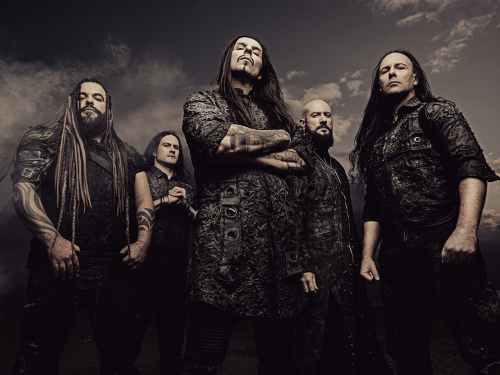
Greek masters Septicflesh have brought their symphonic death metal assault across the Atlantic Ocean, performing as special guests of Arch Enemy and The Black Dahlia Murder for the Wrath Across North America tour.
Founded in Athens in 1990, the band “have a visceral and uncompromising sound that looks as much to the cavernous halls of doom metal for inspiration as it does the icy vistas of black and death metal,” in the words of the always reliable AllMusic.
The group’s neoclassical proclivities have brought them to monumental stages like the Odeon of Herodes Atticus in Athens two years ago and Ancient Theater in Plovdiv, Bulgaria, just last month. For such epic performances, Septicflesh has been joined by a choir and orchestra.
As the band continues its work on a new LP, its first full-length since 2022’s “Modern Primitive,” the North American dates are an opportunity for founding members Spiros “Seth Siro Anton” Antoniou (bass, “harsh vocals”) and Christos Antoniou (lead guitar, orchestrations) as well as musicians including drummer Kerim “Krimh” Lechner to continue to spread their brand of metal on a global scale.
In advance of Septicflesh’s support set for Arch Enemy and The Black Dahlia Murder at Palladium Times Square on Saturday, Oct. 24, we caught up with Lerchner, who hails from Austria, to chat all things Septicflesh.
What does it feel like to be on stage with 100 musicians and a choir and have that power around you as the drummer who is driving the whole thing?
First of all, an orchestra is not as loud as you expect, so there’s always a little bit of war going on on stage, like I’m being too loud compared to them. I always feel a little bit bad because I kind of want to keep the same intensity when I play, so usually during rehearsals, I try to play as quiet as I can, but on a live show I play as usual.
The responsibility is quite, quite high. So the conductor and myself, we are kind of the main guys that are leading the ship. Obviously, the conductor is the guy that gives the OK to start the song, but what I experienced is that an orchestra has a hard time playing to a click track or to some, let’s say, consistent tempo, so that’s something that the orchestra usually needs to really get used to, that there’s someone in the back that gives them a constant time. But I felt like those moments when you let them loose, they kind of start to really shift around as they usually do, but when I start to play with them, it glues it together. So it feels nice that there’s all of a sudden a unity within the orchestra.
It’s great to see how many musicians who have never heard drums being played like this so often. They will turn around during rehearsals or they will pull out their phones and record, or they come afterwards to me, like, “You’re a really good drummer. I didn’t know you can play so fast with your feet,” and to feel that appreciation from someone who has spent all their life perfecting their craft. But classical musicians are a very different kind of breed of musicians, because I’m coming from this kind of passion where I play everything by ear, I play everything without sheet music. I play sometimes longer than I have to or I’m willing to sacrifice a lot. And with classical musicians, they need sheet music and then they are having specific times where they will play and where they will not play. So it’s almost like a job. And for me, that way of approaching music was a bit strange to see them come exactly at 9:00 and they leave exactly at 1 and that’s it.
How are you scaling down that type of presentation for the smaller stages and shorter set times of the North American tour?
Such things like the Acropolis show with an orchestra is an absolute unique thing for the band and definitely stands out of the norm, so our usual headline set with just the band is definitely less demanding. We are going to have a much shorter set time, and this is where the big challenge lays in that we have to find a set list where you kind of have the hits in it. But the problem is the band has been around for a long time, so there are many hit songs. We’re gonna focus mainly on hits and try to actually gain new fans, because this tour, even though we have less playing time, it will be still for us a great opportunity to play in bigger venues in North America than we usually do. The package is great. I’m a big fan of of Arch Enemy and [drummer] Daniel Erlandsson. He has been one of my big influences for many years. So we hope to get new fans. It’s always great to mix up the lineup and be on the road with bands we usually are not associated with.
Where are you at in the process of making the new album?
We have been working a lot of months already. Usually, we take too long to release a new album, but we want to make a good album. It’s five people involved. It’s going pretty well. Like we are in the high season, let’s put it this way, we are more or less towards the end of finalizing which songs we want to do. That doesn’t mean that the songs are ready yet. There’s still a lot of work, but you’re just collecting ideas and then we have to decide, this is a potential song that can go on the album. What I can say so far is that the material itself is on the faster pace, so it’s going to be a more intense album compared to our previous releases. We are in the process of finalizing the song structure, and then we move on to work on lyrics, vocal placement. I have to do still some drum arrangements. So it’s still a lot of work ahead, but it’s going well.
Your guitarist Christos Antoniou also works as a composer and earned degrees at the London College of Music and the Royal Northern College of Music, also in the UK. Is working with someone with that type of training and approach different than working with other types of bandmates?
He is a very different character in terms of how he approaches the music, because we are all songwriters. Christos is usually the guy that brings mainly an orchestration or an orchestral piece that he had in mind, so he always kind of thinks from the orchestra side first and he’s giving you the orchestra that has a lot of layers, and then you try to add the metal part on top of it. What that means for me as a drummer, he sometimes gives me certain cues where he says, “listen to the orchestra, what the flutes are doing or the percussion. Can you kind of follow that rhythmical pattern?” Otherwise, he’s very open. He’s not as like with classical musicians, you need scores, so everybody plays with scores. But he never told me I need to play exactly this kind of thing. I’m lucky. I don’t need to be that exact. I can play what I feel like. But his processing of the music always comes first from the orchestra rather than the metal part.
I’ve been enjoying the band’s “Amphibians” EP from 2025. How did those songs come together?
Actually, what most people don’t know is that we recorded those songs specifically during the same time we recorded “Modern Primitive,” so it was that we recorded with [producer] Jens Bogren back then and we recorded more songs than we actually put on our initial album, because we were thinking maybe to release it later on. But obviously because of the whole pandemic situation, it was more complicated and things got delayed and postponed constantly. Then we decided to release it later on the EP. So it is kind of new songs because people don’t know about them, but for us it feels like we have been playing those songs many, many years ago already.


Leave a Reply