
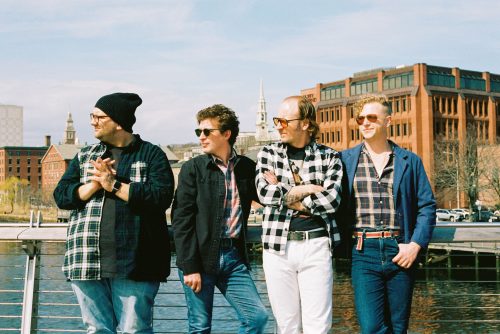
For its ninth studio record, Deer Tick frontman John McCauley gave his songwriting partners in the band an assignment: write tunes about the group’s home state, Rhode Island. The resulting album, “Coin-O-Matic,” fixes a Springsteen-esque lens on the state, and particularly Providence: the working-class folks, the Catholic repression, the relationships inside an assisted living facility and the mafia.
“What I could compare it to the most is like the the reverence and the specificity of culture that exists in Rhode Island from an outsider’s perspective — it’s similar to Texas,” says guitarist, singer and songwriter Ian O’Neil, who moved to RI from Western Massachusetts when he was 21 to join Deer Tick. “I think like the biggest state and smallest state mentality is really not that different. I married into this state, my wife’s from here and I have a ton of local friends and everything like that. But as an outsider especially, you can kind of get wooed into the culture of Rhode Island. That is super strong.”
The band, formed more than 20 years ago, will release “Coin-O-Matic” on June 5 on ATO Records, the same day it will start a three-night stand at Ocean Mist in South Kingston, RI. On June 9 it will hit Warsaw in Greenpoint, Brooklyn, and will return to Newport Folk on July 24.
We recently connected with McCauley and O’Neil over Zoom to talk about “Coin-O-Matic,” how their religious upbringing impacted them, how a heavy metal song snuck onto the record and how New York City played a role in Deer Tick’s early growth.
How have Rhode Islanders who have heard the album reacted?
McCauley: A lot of people have kind of gotten a kick out of it. I guess if you’re from here, the record just feels that way. The record feels like it’s from here. And I feel like we didn’t really go over the top with Easter eggs and whatnot, but if you know, you know.
O’Neil: It’s funny. We have a friend who painted a sign for us. He’s a sign painter around town in Providence that we’re going to bring out on tour with us. It’s really beautiful. And he hasn’t even heard the record, but he was so charmed by us putting that building on the album cover because he knows the history of the sign painting and everything like that on Federal Hill from that era. So I think just if you’re from Providence specifically, but if you’re from Rhode Island in general, it seems like people are charmed by it.
That said, they could just be fictional characters to someone like me who doesn’t know anything about Rhode Island, so the universal appeal is there too.
McCauley: A lot of, or all of, my characters really on the record are kind of amalgamations.
O’Neil: Archetypes.
McCauley: It’s stuff that people pick up on, though. Like my sisters both independently asked me, “Wait, is ‘Dog Years’ about Papa Billy?”
And is it?
McCauley: Yeah. It’s partially inspired by him.
The song “Mary Singletary” deals with Catholic repression. Were you guys raised Catholic?
O’Neil: I went to Catholic school up until I demanded I didn’t anymore, which was like fourth grade or something like that. I don’t know about for John, but definitely at that age, weekly church. And then I think as my parents’ life rolled on, they became more agnostic, especially as their parents passed away. I did my confirmation just to please my elderly grandparents.
McCauley: That’s about as far as I got too, confirmation. I went to Catholic school. I was an altar boy. I really bought into the whole thing. And I think it really stunted my growth emotionally for a while. I had a lot of catching up to do when I realized this wasn’t for me anymore.
The video is really fun, with the band dressed in black metal corpse paint. Who came up with that idea?
McCauley: That was our director, Colin Moore, who is a childhood friend of Ian. So maybe Ian could speak on this.
O’Neil: Colin grew up the same way we did, for sure. We went to the same Catholic school. But he’s an old friend. He did our old music videos for “Main Street” and “The Dream’s In the Ditch.”
He’s an art school kid and now he takes opportunities when he can, when he’s given some creative freedom, to try to challenge the conventions of our audience. And I think he always knows that we’re kind of game for that kind of thing because we’re not so keen on doing the most expected thing with the artistic aspect of a music video or something like that.
It seemed to him like he just loves playing with the idea of this type of music and this perception of the band, then flipping it on its head with something as outrageous as wearing black metal face paint. I think it also probably related to the lyrical content a lot. So that kind of repression the character is feeling in that song almost feels like symbolism by using this kind of imagery in a weird way.
I don’t want to get in his head too much, but knowing where he comes from and knowing his love for that culture, I think he just saw a ripe opportunity to use it in a metaphorical way.
And speaking of heavy metal, “Eyelid” is a metal song, lyrically. I know Dennis wrote that one but I wanted to ask about it.
McCauley: Dennis really had to make a case for that one, to me anyway, because I didn’t really see how it fit. He wrote it years before we started putting this project together. But he insisted in his way that it fit the assignment I gave to Ian and Dennis, which was: we’re writing Rhode Island songs. If nothing else, it’s a refreshing moment on the second side of the album where it kind of comes out of nowhere. The song has grown on me quite a bit. I will admit that when Dennis first wanted to put it on the record, I was pretty against the idea.
You’ll be in New York soon to play at Warsaw in Brooklyn. What role has the city played in Deer Tick’s career?
McCauley: I think without New York and without geographically being so close to New York, our career could have started in a very different way or perhaps not started at all. Just to be able to hop in the car and be in New York in under four hours was great for a band like us when we were starting out. That’s where we got our first real record deal, and I met a lot of people we ended up working with for years. It is the place where things happen on the East Coast for music. Now I guess you could be from anywhere and become famous on social media, but when you had to get out in front of people and play, there was no better place to do it than New York. We were lucky enough to be close to that.

Leave a Reply