
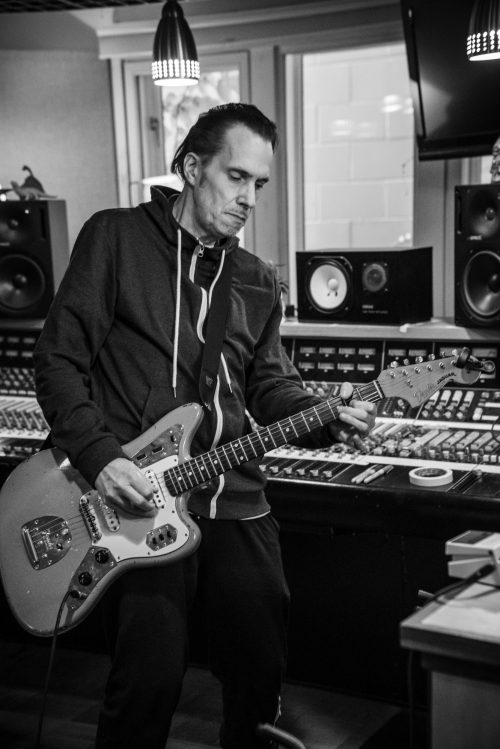
Paul Solger is a name that might not ring a bell with you. But mention him to the A-listers in the Seattle music scene, and you’ll get a response.
“Paul is a cool motherfucker and hopefully some of his style and ease have rubbed off on me over these years since I met him back in 1980,” Guns N’ Roses bassist Duff McKagan, who played with Solger in The Fartz and Ten Minute Warning, says in an email.
McKagan and Pearl Jam’s Stone Gossard have helped the guitarist, who is credited as starting the city’s first hardcore band, complete his first solo album, “20 Years MIA.”
Released earlier this month on Gossard’s Loosegroove Records, the album is an aggressive, cohesive blast of crunchy alternative/punk rock shot through with the attitude that has informed the entirety of Solger’s career. He worked with seven different co-writers and lead singers, but “20 Years MIA” truly sounds like an album, not just a collection of songs. The cohesion could be a product of how the LP began — it’s the culmination of the work Solger started with Robb Clark, the Seattle punk singer who died in 2023.
“Robb and I had a set thing right when we started [working on the songs for ’20 Years MIA’], some basic rules,” Solger says. “We couldn’t go back and use stuff from previous bands. We weren’t going to try to reinvent the wheel. I’ve kind of been notorious for being in a number of bands that were ahead of the curve in a way. When that happens, you usually don’t get what you deserve until whatever you were doing happens five years later. It’s a curse and it’s kind of cool. And we were just trying to make music that we like, the albums we liked when we were young and got us excited. If we could kind of recreate just like even a tiny bit of that, then I think we both felt like we would have succeeded.”
McKagan sings lead and plays bass on the opening track and first single, “New American,” and appears in the music video. He also plays guitar on two other tracks. The album was recorded at Gossard’s studio, and it was produced by Solger, Gossard and Josh Evans, whose credits include the Atmos remixes of Pearl Jam albums, such as the classics “Ten” and “Vs.”
Gossard also penned the song “Twitch” with Solger.
“He wrote the lyrics, and that was about Robb,” Solger says. “There are a few songs about him. That’s why it’s dedicated to him.”
Solger’s relationship with Gossard is a long one. He wrote “Rehab Doll,” the title track of the only album released by Green River (1988), Gossard and Jeff Ament’s pre-Pearl Jam band. Later, Solger says, Gossard helped him with his band The Passengers in the early ’90s and footed the bill for the recordings.
“We always kind of had this mutual respect for each other. And I remember going over to his parents’ house and teaching him songs from Goats Head Soup and shit like that,” he adds, referring to the Rolling Stones’ 1973 album.
“I started going to see underground shows at clubs in ’84,” Gossard says in an email. “Witnessing Paul in bands like the Fags and 10 Minute Warning was a revelation. He was pure effortless cool. Sneaky, snaky riffs, noise, perfect mistakes, Johnny Thunders slides. He was the James Dean of Seattle rock. Paul played fast and slow and psychedelic. He did it all. I was in love.”
The two didn’t speak to each other for a year at one point, Solger says, because he was under the impression that he wasn’t credited for “Rehab Doll.” One night they sat next to each other at a bar and Solger brought up the perceived slight. “He pulls the album out of the DJ booth. I was credited. Some asshole had told me I wasn’t.”
Solger’s move to Yakima, Wash., to take care of his elderly parents, and his own stomach cancer diagnosis and recovery kept him away from the Seattle scene and making music.
Earlier, when grunge became a worldwide phenomenon, “I didn’t pay much attention to it. I just got clean and sober, so I was fine. I kind of set the guitar down for about nine months.”
When heard his name mentioned as a forefather of the genre, “I didn’t like it at first, because I didn’t see [my influence] or hear it, but after a while, I mellowed to it. If people are gonna say that I had something to do with the blueprint, I’ll run with it, because somebody else will [otherwise].”
Much of the talk about Solger’s influence on grunge is due to 10 Minute Warning, the group he and McKagan formed in 1982 after the dissolution of The Fartz. With the benefit of hindsight, he can see how the band, known for slowing the tempos of punk rock, set the stage for the multi-platinum bands that would emerge from the Emerald City in the late ’80s and early ’90s.
Looking at old photos of a 10 Minute Warning gig, he saw in the audience Kim Thayil from Soundgarden and the members of Mudhoney.
“Drummers were all watching Greg [Gilmore] and guitarists were checking out me and Duff,” Solger says. “If that inspired them to do something that was successful and made people happy, then I got to be happy about it. I may have had a bad, not so cheerful [attitude] about it at one point, but I don’t think I was very cheerful about my whole life at that point. So as I got older, I appreciated it.”
At peace with his musical past, Solger is energized about the present and future. There will not be another long layoff until he makes music again, he says, and without hesitation calls “20 Years MIA” “the best thing I’ve done.”
“I like the things I’ve done. But there’s something special about this one,” he says. “It hadn’t dawned on me to ever [make a solo album]. I have to lose one of my best friends for that to happen. I don’t know what to think about it. I don’t know about people in the afterlife or however that goes. But there sure seems to be some other hand at work in this. Things happened that were just too coincidentally perfect, you know? I gotta wonder sometimes.”

Leave a Reply