
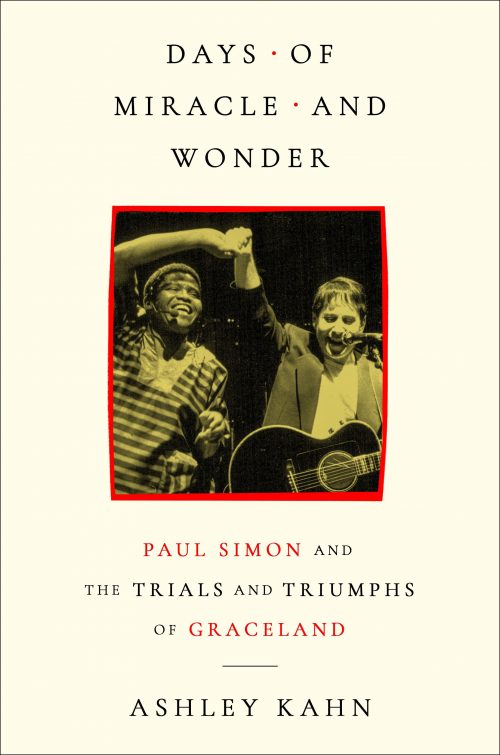
In retrospect, Paul Simon’s “Graceland” is venerated not just as a brilliant, timeless, genre-spanning album, but something more broadly important: a bridge between the west and Africa during the height of the anti-apartheid struggle.
In the moment of creation, however, Simon was in no way convinced his concept would work, never mind become a cultural pivot point.
“I think that Paul is someone who is always second guessing himself and putting himself through a process that maybe he would not want to do again,” says author Ashley Khan, whose book “Days of Miracle and Wonder: Paul Simon and the Trials and Triumphs of Graceland” is published today. “I think the real lesson from ‘Graceland’ is that what he was working with had both rhythm and harmony, and he had to find melody to make it work, and it just added this extra layer of challenge. He was self-doubting. This is the guy who did two versions of ‘Think Too Much’ on his previous album.”
“Hearts and Bones,” the previous album, was a commercial flop, adding to the pressure on Simon to deliver the goods. He took financial and reputational risks to follow his artistic vision, decamping to South Africa to work with local musicians after becoming entranced with the music on a cassette of music from the country that was given to him.
Kahn, who co-wrote Carlos Santana’s autobiography and has won a pair of Grammys for best album notes, takes readers on Simon’s initial trip to Johannesburg, where national rules prohibited black and white musicians from performing together in public, and subsequent work in New York and on a world tour.
Simon was taking a chance on working with strangers not familiar with modern recording techniques, some of whom didn’t speak English, but they were taking a chance on him as well, considering the political tensions and related violence.
While Simon was determined to get the sounds he was hearing in his head, he gave the African players freedom to find it.
“He dealt with different musicians in different ways,” Kahn says. “So there was a whole wide variety of how he would collaborate and whether he was sort of running stuff from the control room and giving direction or if he was in the live room with the musicians actually making music with them. Every group, every situation was different. On ‘Graceland,’ he gave himself the flexibility to work in many different ways. As you know, I’m not privy to how, let’s say, Peter Gabriel worked with Youssou N’Dour. I’m not privy to how Sting worked with Cheb Mami, one of the top raï singers and musicians of that moment.
“The difference with Paul, I think, is that one, it was much more transparent. He did many interviews back then. He would do press conferences before each and every concert. His collaborative approach was something that he was very open to talking about.”
Kahn notes that Simon could have more easily made the album with New York session musicians from his inner circle who were “certainly up to the task.”
“He said to himself from the start, ‘I want to work with the musicians who are on this bootleg cassette that I’ve fallen in love with.’ He had come off a not-so-great-selling album, and in all my research and in Robert Hilburn’s biography, etc., Paul makes the effort to zero the books so that when he’s now working on this new project, one, it’s not a Simon and Garfunkel project as the album before had initially started to be, so he’s clear on that, and he’s very clear on what he wants to do. He wants to work directly with these musicians.”
The book details the backlash the ensuing tour met from some in the anti-apartheid movement, as it broke the UN’s cultural boycott, which was intended to isolate the country from international culture and sports and in turn force the government to end apartheid. Some activists accused Simon of stealing from African culture for his personal gain. Paul Weller and Billy Bragg joined protests in London.
“He was acutely aware of who he was, his stature, and of course, the sense of entitlement that this is someone who can write a check and then make a project happen,” Kahn says. “What dials back the appropriation charge is credit, and Paul bent over backwards to make sure credit was given, and compensation, and the idea of sharing the copyrights and giving not only credit where it was due, but money where it was due.”
Among the many South African musicians Simon enlisted to play on “Graceland” was Ladysmith Black Mambazo, the all-male vocal troupe who sing in the local isicathamiya and mbube styles. In “Days of Mircale and Wonder,” Simon is shown to be nervous about inviting the group to participate, and he holds its leader and founder, Joseph Shabalala in very high esteem. After the two first meet, Shabalala remarks that it was the first time he had hugged a white man, an embrace that could be seen as emblematic of the coming together of cultures.
“Listen, things were about to change, and things would have changed with or without ‘Graceland.’ I don’t want to give ‘Graceland’ too much, you know?” Kahn says. “But at the same time, ‘Graceland’ did throw an extreme spotlight on the South African situation, which was already in the news. It kind of humanized the whole situation, so it wasn’t like another Ethiopia, ‘let’s help the struggling famine victims.’ It was, wait a minute: This is a hugely vital, well-established culture that is there with its incredible music that is so life-affirming and positive.”
Kahn, who was Ladysmith’s tour manager when the group was part of Simon’s band on the “Graceland” tour, teaches at NYU’s Clive Davis Institute for Recorded Music. His research for the book included interviews with more than 100 musicians, record label staffers and others who witnesses the making of “Graceland.” Simon, the central character, was not one of the interview subjects. To help paint a full picture, the author relied on historical interviews the singer-songwriter did in conjunction with the release of the album and a subsequent anniversary edition.
“One, Paul is talked out on this topic. It’s very clear,” Kahn says. “Two, I know the management and it was agreed upon that I was going to work towards just that: I would interview everyone else. My driving imperative was simply the idea that there’s so many witnesses, participants, etc., and their voices have never been heard. So I wanted this kind of virtual roundtable where information, facts, insights and memories were coming from a variety of different places. There’s also this thing of editorial independence that Paul has spoken about, especially the controversial aspect, so that it was much more valuable to get his words from when all of this stuff was happening in real time.”

Leave a Reply