
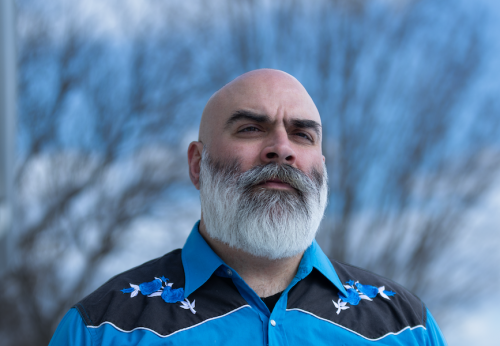
Even A-list artists can send an audience running to the restrooms and beer lines with the words “here’s one from my new album” — especially when the album in question hasn’t been released yet. However, Jacob Augustine, the Maine-raised nomadic performer with a robust, arresting voice, has had the opposite experience when singing material from “I Love You Forever,” out May 22.
“I played a show in Charlotte and I opened with ‘Medulla Burning Down,’ the first song on the album,” Augustine recalls in a recent phone interview. “I usually play with my eyes closed, and I opened my eyes and looked at everyone in the room, and like they were completely frozen in time. Like they didn’t even applaud. They were just staring, sitting there staring at me, and I thought maybe I was in the matrix and finally glitched, you know? I was like punched out and I waited a good 10 seconds and there was no response. It was just people staring with their mouths open. And then I kicked in to ‘Halfway to Harlem,’ and then they kind of realized that they had not [responded]. And then there was this big roar and they all start laughing and stuff, because we all kind of had that moment together. That was the first time that’s ever happened.”
The moment was notable but not out of character for people who have heard these songs live.
“It’s been wonderful. It’s great. I don’t think they’ve heard this music before, and I don’t think they’ve ever even heard who I am before. I’m kind of relying on the local support right now more than anything. And it’s been awesome. I mean, everywhere I play, they’re kind of stunned. People come up to me and you can tell they’ve been crying or they want a hug.”
Augustine wrote most of the songs after he returned home to care for his sick mother and grandmother. His mom, a devout Catholic but one who let Augustine’s death metal band rehearse in the basement, got caught in the web of the US health insurance crisis.
“There’s kind of a thread there with how our health care system works, especially in ‘Philadelphia Lights,’ which kind of touches on that a little bit. There were moments where she was being well taken care of. There were moments where she got her insurance, and there was a fundraiser at the Knights of Columbus halls to pay her hospital bills.”
Augustine spoke fondly of the way his mom was initially cared for in Philadelphia, where she was being treated.
“She was being flown down to a cancer center there for some time, and her insurance company basically dropped her. She really enjoyed how she was treated down there in Philly. They’d pick her up in a limo at the hospital or at the airport, and they’d drive her to her treatments and they’d have classical pianists inside the building waiting for the patients. It was kind of a pleasant experience.”
Growing up in tiny Lincolnville, Maine, Christianity was everywhere. “There’s one street they call the highway to heaven. And it’s just church and church and church and church, and it’s like evangelical churches and Pentecostal churches. And those are really strict. So we always saw those kids and felt sorry for them because they weren’t allowed to listen to a Metallica record. They kind of had a sheltered life. So in some way, I did identify with being Catholic growing up because I was proud that we were able to live and be ourselves.”
A dark side emerged, however, when an elderly priest — “he was kind of like our pal and our youth adviser” — “was preying on children the entire time,” Augustine says. “So that was like a real head fuck.”
Augustine, who now calls vocal stylists like Frank Sinatra, Ben E King and Antony as some of his favorites, says: “I was a hardcore punk metal kid growing up. I used to play CBGB’s a lot and around the corner from there on Bowery, it was a record store and it had all these really obscure, cool things in there. I started to discover really old Delta blues music, and I started to learn to cover Robert Johnson songs. That’s when I learned that I could actually sing, sing to a tune.”
Another important voice on “I Love You Forever” is the pedal steel guitar, played by Hamilton Belk, which at turns envelops, supports or interacts with Augustine’s singing.
“Once you get in the room with pedal steel guitar, you never want to be in a room without a pedal steel,” he says. “They’re just beautiful. And so I wanted something that would complement the vocal. like a kind of a call and response, but something that was also kind of a soaring kind of sound, because there’s a lot of sustain and I sing with a lot of sustain. I guess I don’t think it’s an angelic voice, but a lot of people say stuff like that. So I feel like that pedal steel helped quite a bit. And also because I’m from a very rural conservative place, and for some reason, that kind of pedal steel vibe fits for a lot of the songs, which are stories coming out of that place. So it kind of gives a bit of a backdrop to the subject content off like rural, conservative, white America, MAGA America or whatever.”
The album is Augustine’s first in more than a decade, following the period when he was caring for his mother and dealing with his own issues.
“A lot of the big hiatuses I took is because of health struggles, and I never knew what it was. I just felt like I was a total fuck-up, you know? Especially after losing mom, I built a little tiny house somewhere and I just disappeared off the face of the earth for a long time. I didn’t know why. It seemed like everyone else was handling the grief better than I was, and I didn’t really know why. And then eventually I finally went to a doctor and I was like, I think I have ADHD or something. And they ask me a bunch of questions and said have you ever heard of bipolar disorder 2 before? I was like, yeah, sure, but that’s not me. Over time I understood it more and I learned more about it, and I’ve got to a point now where I don’t take meds for it or anything, but I’ve gotten to a point where I really like govern it quite well and manage it quite well.”
Calling music-making “a life of service,” he hopes the long gaps between records is over.
“No, I think I’ll be right at it. We actually have the next album, the bones are already recorded for it. So I’m kind of way ahead. I’m writing the third album from now and the second one’s already down. If everything goes to plan, I plan to drop an album every year.”
Jacob Augustine with Tuxi Giant and Noble Beast, Friday, May 15, 8:30 p.m., Footlights Presents at The Windjammer (552 Grandview Ave., Ridgewood, Queens), info here.
This interview has been edited for length and clarity


Leave a Reply