
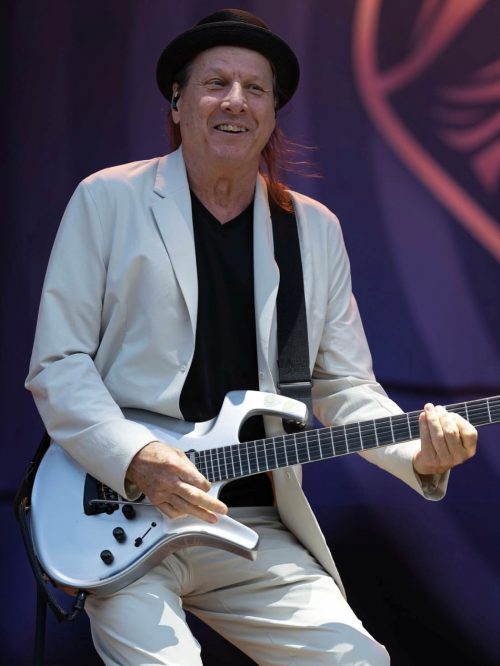
Don’t expect Beat, the all-star ensemble that celebrates the ‘80s era of King Crimson, to break into a version of “We’re An American Band.” But the classic Grand Funk Railroad anthem would be oddly appropriate.
While Robert Fripp launched King Crimson in 1969 as a distinctly British group, the bandleader and only constant member made so many lineup changes that the forward-thinking, post-rock version in the ‘80s ended up including two British musicians and two American players.
Forty-plus years later, Beat, also a four-piece, features only Americans: guitarist-singer Adrian Belew and bassist Tony Levin, both from the ‘80s KC; guitar virtuoso Steve Vai, stepping in for the retired Fripp; and Terry Bozzio, covering drums, as Bill Bruford from the ‘80s crew has also mostly retired. (Danny Carey of Tool, another American, occupied the drum throne for the first edition of Beat.)
“I think the band we have now is much more of an American approach to the same music,” Belew says during a phone interview before rehearsals commenced for the fall Beat tour, which includes a concert at NJPAC in Newark on Monday, Nov. 9. “You have to go back to playing with Robert and Bill: that was the invention of the music. There is a big difference, I think, between the styles of the people we’re talking about. And I suppose if you were to put it in simplest terms, I think Beat has a swing that King Crimson in the ‘80s did not have, but King Crimson in the ‘80s also had other great points about it. They were very precise players, Bill and Robert. And without the four of us in the ‘80s, there wouldn’t be this group now.”
Asked about musical or cultural differences that might have presented themselves when he and Levin first connected with Fripp and Bruford, Belew says: “We used to kind of laugh that the English guys loved to sit and analyze the music and talk about it and talk about it, and then Tony and I would just walk in and want to play. There’s that little bit of a cultural difference, but nothing that made any difference to our relationships as people and players. I loved working with those guys just as much as I love working with Tony. So that’s an interesting experience. When you have a multinational band, though, there are things about it. There’s actually something about it that I feel brings a lot of respect to it, because these are the best people from two continents to do what they’re doing.”
The concept of the ‘80s version of King Crimson was so different from Fripp’s previous incarnations that the band initially worked under a new name, Discipline, which eventually became the title of their first album when the KC moniker was revived instead.
Bruford had been in the 1972-74 band that made the albums “Larks’ Tongues in Aspic” and “Red,” while Levin had been a member of Peter Gabriel’s band since he departed Genesis. Meanwhile, Belew was an in-demand guitar experimenter having worked with Frank Zappa, David Bowie and most recently Talking Heads, where he played on their masterwork album “Remain In Light” and its accompanying concerts.
“Remain In Light” is renowned for its adoption of African music, and the continent’s rhythms and interlocking guitar lines were subsequently pursued by the Discipline-era Crimson.
“It did open my eyes to more of the African approach with a lot of African kind of guitar playing and rhythms,” Belew says of his tenure with David Byrne and company. “And then when I finally made a record with them, it was filled with rhythms. You had so many tracks full of different things. You could basically change in mid-song to a completely different thing if you wanted to. I guess it affected me.
“I don’t know for Robert or anyone else, but I would also say this: that was the feeling that was in the air. I noticed in that short time period, I spent a lot of time getting to know people in the music business, in New York City, especially, and that seemed to be the interest for Peter Gabriel and so many other people. It didn’t affect everybody. I don’t think David Bowie went that route, but most people were discovering that.”
Paul Simon would famously work with South African musicians for his “Graceland” album, and, probably not by coincidence, Belew recorded on that release too.

While Beat was formed to honor the Crimson that made “Discipline,” “Beat” and “Three of a Perfect Pair,” the group has added some material from the underappreciated ‘90s era that made the album “THRAK.” That configuration of KC was conceived by Fripp as a “double trio”: two guitarists (Fripp and Belew), two bassists/Chapman stick players (Levin and Trey Gunn) and two drummers (Bruford and Pat Mastelotto).
“Since this is our second run across the United States, I know there will be some people who saw us before, and I wanted to make sure that we lure them back by having other things that are different that you wouldn’t want to miss,” Belew says. “So some ‘90s material, I think, would help that and would strengthen the overall show to replace whatever kind of weaker songs we think we have from the ‘80s to something more substantial from the six-piece ‘90s band. And then also you have Terry Bozzio now, and that’s a big difference, because Terry has a unique style every bit as much as Danny does. So it’s for all of us. We haven’t played a note together, but we’re all waiting anxiously to see what this band will sound like. So I think I think it’ll be amazing, just like the last one was.”
When Fripp assembled the final version of King Crimson in 2013, the most notable bit of the news for many fans was the absence of Belew.
“At first I was OK with it. I thought, well, you know that’s fine. He wants to go in a different direction,” Belew shares. “And I was very busy. I was working on a creation called Flux, where it was music that is never the same twice, and pretty quickly after that I was asked to do the Pixar short film ‘Piper,’ which won an Oscar. I was too busy to do anything anyway.
“But when they started touring, then I really felt left out, and it really hurt me, and I started getting even a bit depressed by it. Like, I don’t know, maybe I don’t want to be in this business anymore. It was a huge distraction and not a nice one. So I dealt with it by simply turning off all social media and not having anything to do with it. I sort of said to myself, well, I’ve had my 33 years in King Crimson, I don’t need to know anything more about King Crimson. I’m out of it. That’s fine. I’m moving on. But still, there were a lot of times when I would just think, what? What happened here?”
As Crimson played its farewell run without him, focusing almost entirely on its 1969-1974 material, “which I loved dearly,” Belew says, he notes that “they weren’t touching that much of the ‘80s version. So I kept having these nightmares that maybe my King Crimson will be forgotten. I also had a lot of information from people on my Facebook page about how much they love those songs in that particular era, or it being their favorite era. So I thought, maybe it’s time to shine the light on that again.”
The first step was to call Fripp.
“This was in 2019, and I reminded him that in two years it would be the 40th anniversary, so maybe we should do something, and would he be up for that? I didn’t have any program, any agenda. I just thought we could play a couple major cities and call it a day if you wanted to. He told me that he had three years planned ahead already. And he did say to me, ‘If you want to drive this’ – I like that term, ‘drive this’ – ‘then I’ll give you my blessing.’”
Covid delayed Belew’s plans, but Beat finally hit the road in the fall of 2024, released a live album and is back out this autumn.
Fripp and Bruford have both attended Beat shows and have posted positive reviews and photos with the current band on social media.
The choice of Vai, known for a flashy style that puts him in a pantheon of “shredders” such as his former teacher Joe Satriani, to join Beat raised some eyebrows, but Fripp gave his stamp of approval. Vai approaches the material with reverence and refers to the Crimson maestro as “Father Fripp” in his social posts.
“Steve worked on this music for five months solid,” Belew says. “There were many, many times when he would call me and ask me questions, and there were other times when he would send me a video of what he intended to play and let me sort of critique it and say, ‘Yes, maybe we do this a little differently’ or something. I rarely had comments, because he was doing so great, but my main instruction to him and Danny both was play the essentials the way they are supposed to be. We have to have, for example, that interwoven guitar stuff. But beyond the essentials I want I want it to sound like Steve Vai and Danny Carey.”
Belew continues: “I know Steve in particular did not want to offend Robert in any way, and Danny was trying his best to kind of follow in the steps of what Bill had put down. But eventually they came out of that and started being themselves.
“It reminded me a little bit of what happened to me when I joined Discipline, which turned into King Crimson. When I first started, I had to learn everything the way they were doing it. I had to learn to play those guitar parts that Robert was playing. After a while, you lose yourself and you go, well, wait a minute, this is not who I am. And then one day I walk in and I just start making elephant noises [on the guitar] and doing my own thing, and that really broke the ice. And away we went.”


Leave a Reply