
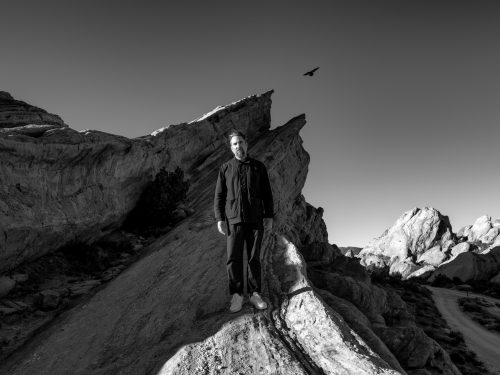
For his ninth album as The Album Leaf, Jimmy LaValle recruited 10 guest vocalists to help bring his atmospheric music to life in a new way. The appropriately titled “A Body Of Voices” features artists such as Twin Shadow, Theresa Wayman of Warpaint, Nicole Miglis (Hundred Waters) and Stephen McBean (Black Mountain & Pink Mountaintops) lending their voices.
“This is an idea that has stirred for a while, to do an all-vocal collaborative album,” LaValle says during a video interview from his studio in Los Angeles. “This was a collection of songs that I kind of felt had room for a vocalist, and then also with that thought, I really wanted the vocalist to be able to really navigate their own journey within their performance. What I mean by that is, I think a lot of my songs don’t have obvious changes, if that makes sense. Like I might do subtle things like change a bass note on this turn around or something like that, and that to me is enough of a change or a vibe switch, so I wanted these vocalists to create their own choruses, create their own ‘-ness.'”
Raphaelle Standell-Preston, who fronts the groups Braids Blue Hawaii, was an impetus for the LP, he says.
“Raphaelle’s work with Blue Hawaii was really a huge inspo for me because of the way that she performs and the way that she’s able to really create a journey, and I think she does that really well in this song, ‘Take Me,’ the one that we did together,” says LaValle. “I think that that was kind of a benchmark or maybe a goalpost of what I was kind of expecting. And I’d always been really inspired by her delivery in particular. So my first thought was kind of inspired by her and the way that she can really take you places in one performance.”
LaValle, then based in San Diego, emerged as The Album Leaf in 1999 with the album “An Orchestrated Rise to Fall” and released records on important labels like Sub Pop, while composing for Netflix features, film festival standouts such as “Things Will Be Different” (SXSW 2024) and “Touch Me” (Sundance 2025), as well as for the Calm app.
“A Body Of Voices” was released at the beginning of October. The Album Leaf will perform as part of the Numero Group label’s 23rd anniversary celebration at National Sawdust in Brooklyn on Nov. 14, where LaValle’s band, as well as Laraaji and Shira Small, will perform an album in full. The Album Leaf will play its 2001 second record, “One Day I’ll Be On Time.”
LaValle chatted with me about how he made “A Body Of Voices” in a different manner than his previous albums, what synthesizers and pedals he used, why the Fender Rhodes electric piano remains his “ride or die” and how he used AI to plan his setlist for a festival gig.
Did you also have certain lyrics or lyrical themes in mind when you were imagining vocals on these songs?
So I had this collection of songs and I basically had it posted on like a playlist, and as we reached out to collaborators, they just picked their songs. So they got all instrumentals with a lot of the melodics already kind of in place, and then I guess the correct term is they top lined with their own delivery, and then I then responded to their vocal takes on my own. So basically they would deliver their vocal and then I would further produce their vocal and further kind of produce the song, kind of finding what [additional] melodics I could add or support their melodies, stuff like that.
Is this process different from how you usually make Album Leaf records?
Yeah, definitely. Lyrics and theme have never really been a focus of mine. It’s not to say that I don’t care about them. I don’t have thoughts about it, but that’s really kind of where I lean on the collaboration. I want the collaborator to bring what they’re going to bring and kind of give them free rein. So that’s kind of an unusual approach. I did a record with Mark Kozelek [Sun Kill Moon] many, many years ago, almost 13 years ago, and there was a similar kind of approach there where I didn’t produce his vocals further, he was more particular about how he wanted his vocal to sound, and it was more of a collaborative record from front to back. But I did send him songs and then when he would deliver his vocal, I would mix it in and then I would add more kind of structurally and just respond to it. So I feel like I think that’s the beauty of collaboration is the back and forth and the responding to something that’s been delivered.
Stepping away from the words and focusing on the sounds, was there a specific sonic world you were building?
Not really. I do feel like as someone who’s released records for almost or for 30 years, I kind of evolve and get into my own kind of sonic loops or, you know, this is my favorite synth at the moment. So a lot of it’s based around that, or like, I just learned this production technique. I got really into a specific effect on the vocals that I was using kind of over and over again on this Eventide H9 pedal. I ran a lot of outboard effects. I use a lot of stomp boxes and things like that and in ways that are conventional to me but maybe not with what you know. I think pedals are made to do whatever they want, but often you think pedals and it’s like a guitar pedal. I’m obviously a synth guy. So I run all my stuff, all my synths, and from my Ableton rig I can send audio through the pedals at any point and print it and fuck with it and manipulate, and that’s kind of part of my process. So I was really into that sonically, and I think that that kind of goes throughout the entirety of the record.
What were your primary synths for this album?
I use a Novation Peak and Summit, which are essentially the same synths. The Peak is kind of the desktop version without a keyboard and the Summit is two Peaks in one and you can split keys and split voicings and it’s an actual 61-key synth. That Moog d fam I use a lot for beats. I use Make Noise kind of in a melodic way. Gosh, what else? I mean, there’s all kinds of stuff all over it. I think a lot of my pedals are kind of key, like the Eventide H9 was really key for it. Gosh, trying to now rack my brain because the gear side is my pride and joy. I do a lot of sample manipulation within Ableton as well, so I do a lot of sampling and reprocessing and audio manipulation to kind of create new synths and then create new sounds out of samples, and things that I’ve sampled making them melodic.
As technology has developed since you started making music, do you think it’s changed the way you compose?
Absolutely. I was a little late to this [interview] because I just got lost in this new piece of gear that I got. It’s this little four-channel or four-voice granular sampler and I’m just figuring out how to kind of load things in it and perform it, and it’s just really fun. There’s so many tools available. Also, the way I perform has changed immensely utilizing Ableton as opposed to the way that I did 20 years ago or whatever. Obviously the Rhodes has been there the entire way through, You know, my ride or die. But I mean the synthesizers that I use have changed, but essentially the need-to, go-to synths have always been there.
But you know, production techniques, obviously, ‘ve gotten better as I’ve made records for 30 years now. And, and yeah, again though, I mean, I kind of just still keep falling into my own little production ruts of like, oh, this is what I’m doing and I gotta do this. And, you know, so I’m kind of Excited for the next chapter of whatever is going to is going to come.
Why is the Fender Rhodes a special instrument for you?
I think from the very first time I played it, I just fell in love with it. I was actually playing drums for a band called go, go, Go Earhart, and after the Rhodes was set up in the living room that we practiced in and after our practices — that band they would live record all practices and that would essentially turn into their records, which was really a cool thing, kind of edit the jams together. After those practices, I was like well, what is that thing? and then just play it. And then it kind of turned into like, oh, can you teach me how to play this thing? I was just like, God, this thing is, I don’t know, just the way that they’re very human in a way that they’re all unique. II toured with it through the States and then I would go to Europe and I’d have to rent one, and the way that it would respond would not be the same, and the way that it played wasn’t the same. The sound that I could get out of it wasn’t the same. I have a very particular Rhodes chain and sound that I use, and I could never recreate that.
Have you been able to harness AI?
I haven’t done it in regards to Album Leaf records. I have been able to utilize it more in the film space with composing with scoring. But I had a show at the post Festival in Indianapolis, and it was like only an hour or 90 or 75 minutes or something like that, and I chose a batch of songs, and then I put those song titles and BPMs into ChatGPT and said “make this into a set list,” like creating a vibe and an arc and an intro, and they’re like, “oh, this,” and then they totally gave me three different options of set lists. They mostly were kind of in my order already, but a couple things changed here and there, and I was like, “oh, that’s cool.” I’ve utilized it in those kinds of ways for music. But there’s a company called Output that you can kind of put in prompts that you’re looking for and they’ll create like sample banks for you. I’ve done it in the way of like, I’m scoring a film that’s about this and it’s set in this time period and it’s set like this. What do you think would be cool for instrumentation? And it’ll respond and give me some ideas. Yeah, things like that.


Leave a Reply