
The concept that says the same object can be perceived differently from different viewpoints, or parallax view, is used in astronomy, trigonometry and other disciplines. On a metaphorical level, it is the broader acceptance of a shift in perspective.
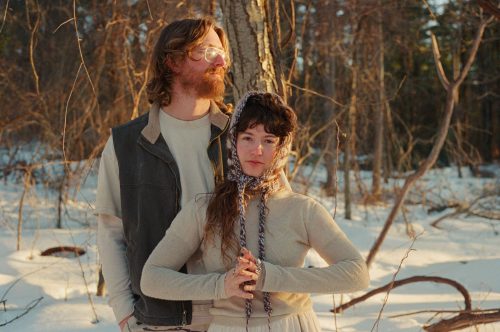
Babehoven, the Hudson, NY indie-folk duo of singer-songwriter Maya Bon and multi-instrumentalist Ryan Albert, have mined the concept on their third LP, “I See Them, I See Me.”
On the new album, Bon’s lyrics reveal a deeply thinking, deeply feeling writer, and her intimate and direct vocals, blended with rustic, sometimes dreamy instrumentation have built a universe that is uneasy and comforting at the same time.
“I See Them, I See Me” also comes in the wake of personal health challenges. During the band’s first headline tour in 2024, Bon suffered from paralysis of her right vocal cord. Around the same time, she underwent nine high-dose ketamine therapy sessions for depression.
Following an album release show at the Avalon Lounge in Catskill, Babehoven will return to the stage for shows in the Northeast, Midwest and West Coast, including stops at Johnny Brenda’s in Philadelphia on Thursday and Baby’s All Right in Williamsburg on Friday. Jane Lai will open both shows.
Bon and Walter recently opened up about their view on parallax, how the ketamine sessions influenced the album, literary influences and their beloved cats, which feature in one of the record’s prettiest lyrics.
What was going through your mind when you realized you had paralyzed vocal cords? How did regaining your voice, literally and broadly speaking, affect your approach to making these songs?
Maya: When I discovered that my right vocal cord was paralyzed, I felt deep fear set in. I was told that it was possible that it may recover but that it wasn’t guaranteed, that I could be in discomfort speaking and singing for the rest of my life. I was terrified. My voice had always been a rock in my life, something I could rely on, turn to in difficult moments and trust. I had never thought that I wouldn’t have that forever. It literally hadn’t crossed my mind. In a way, I’m grateful for the experience now in hindsight because it has taught me that nothing lasts forever and we must appreciate what we have while we have it. No one’s voice will stay the same forever. Since recovering and retraining my voice, I have felt immense gratitude for my ability to sing. I feel immense relief that I am able to sing, that I’m able to perform comfortably and to write without worrying about what my voice can and can’t do. In a way I feel that my voice has more control now than ever. It is different than it was pre-paralysis, but because I have trained so extensively, the difference is mostly positive. I am more restrained but I honestly think that is overall a positive thing. I know what I can do and I won’t push myself too hard.
Did ketamine help your depression? Did you write while under its effects?
Maya: I didn’t write while I was in the ketamine treatment itself but I certainly wrote many songs around my sessions. I was encouraged by my therapist to try ketamine therapy for depression and it was a life- changing experience. It helped me work through some of the depths of the pain I was in and shift things around a bit. I definitely felt creatively inspired from the experience but I wouldn’t say the ketamine therapy itself impacted the way I write. It made me feel differently and experience new ways of thinking that came out in my music.
Tell me about the concept of parallax and how it relates to this record.
Maya: We became interested in the fact that two people can experience the exact same thing and have completely different experiences of it. And neither person is necessarily wrong. You’re just standing somewhere different.
The word parallax describes this change in the apparent position of something depending on where you’re looking at it from. We liked that as a way of thinking about relationships and perception. You can be extremely close to someone and still not fully understand what they’re seeing.
We didn’t sit down together and decide, “We’re going to make a record about a parallax view.” It was more that we wrote a bunch of songs and then started noticing that they were all circling this idea. We tend not to know what a record is about until it’s already there.
Much of your material is layered, complex and unpredictable, but it is relatively easy to digest. How do you balance your interest in making challenging music with making music that could appeal to folks who aren’t musicians or particularly adventurous listeners?
Ryan: We don’t intend on making our music challenging or not challenging. Though what you’re hearing may be because we are not super-trained musicians. We also really enjoy harmonically complex music. So when you put those two things together you get basic chords that maybe are a bit more cloudy and impressionistic than normal. A good example of this is our song “Peloros.” The chords are actually super easy, however they would all be bar chords if you played the song in standard tuning. This is a hard thing to do over a prolonged period of time. However, if you tune the guitar to something close to an open C minor chord, all of a sudden the chords could be played with a single finger and also sound more lush, unique and complex. Many years ago I came to the conclusion that my favorite-sounding chords rely on using only two fingers even when the traditional chords require more. Often this means having more unfretted strings ring out whatever the guitar is tuned to. This sounds better to me.
There is a palpable love of language in your lyrics. What are some things that can inspire or inform your writing (books, lyricis, films, etc.), and can you give an example or two?
Maya: As a songwriter, I definitely am inspired by books I read, songs I listen to, films I see. An example of a book series that emerged in our song “Lightness is Loud” is the “Three-Body Problem” by Cixin Liu. I was thinking about the dark forest theory that Liu writes about; that emitting light to contact other beings in the universe is fundamentally dangerous. The phrase “your lightness is loud” popped into mind. I liked the idea that something visible could be synesthetically considered audible.
Your cats are mentioned in your press materials, so I wanted to ask about what role they play in your lives and your lives as artists.
Maya: We have three awesome cats. Two of them have no eyes (hence my lyric in “Wave Has a Place”: “three cats, two eyes, seeing with the sound”). They are amazing creatures. They inspire me every day to see the world differently (a parallax “view”). The way they navigate the space using their other senses is a magical thing to behold. They are also so smart and playful and brave. I love our cats!


Leave a Reply